Silver stater of King Monounios
Srebrni stater kralja Monouniosa
Drag to rotate · scroll to zoomDrag to rotate · pinch to zoom
loads {mb} MBObjects that were not scanned but reconstructed: the Old Town as a 3D model from open spatial data and, from photographs, the figurine Diva Rumina of Ulcinj, an anthropomorphic slab figurine of fired clay and the oldest object in the collection, a gem with the head of Athena from the 4th–3rd century BC, a side of the 9th-century ciborium (National Museum in Belgrade), the plaque with the IHS monogram in the Old Town, coins of Illyrian kings and cities, of medieval Ulcinj and Svač and of the Roman Empire, and finally an Illyrian-type helmet as a sample. A reconstruction is not identical to the original: shape, ornament and dimensions may differ. An exact model will come from 3D scanning the original, and for the town from a drone or lidar survey.
Description
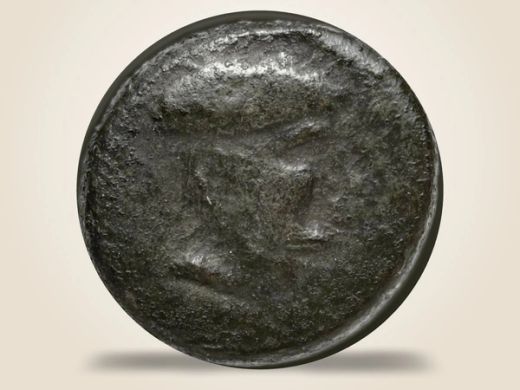
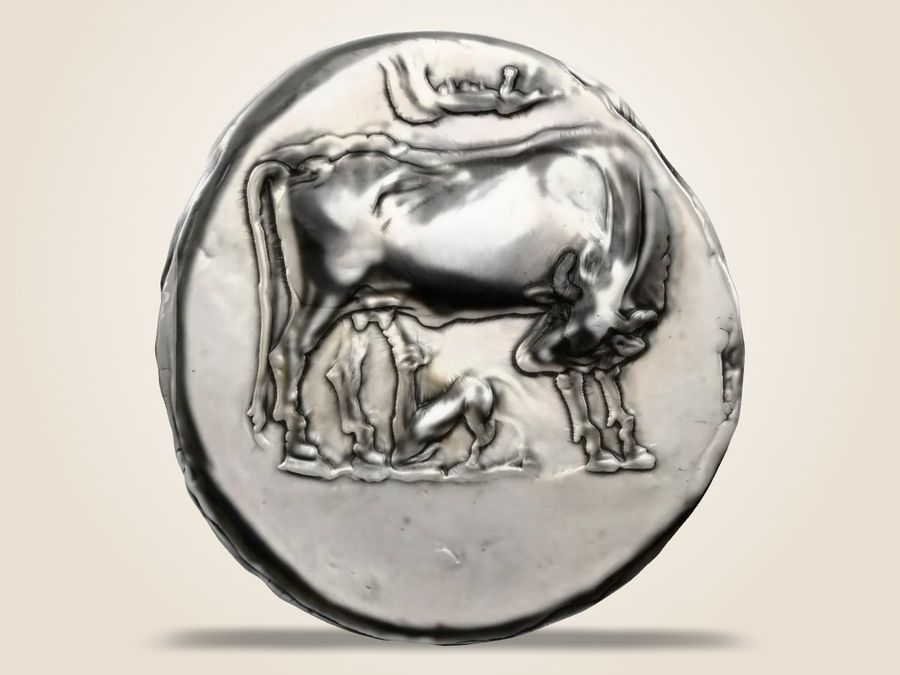
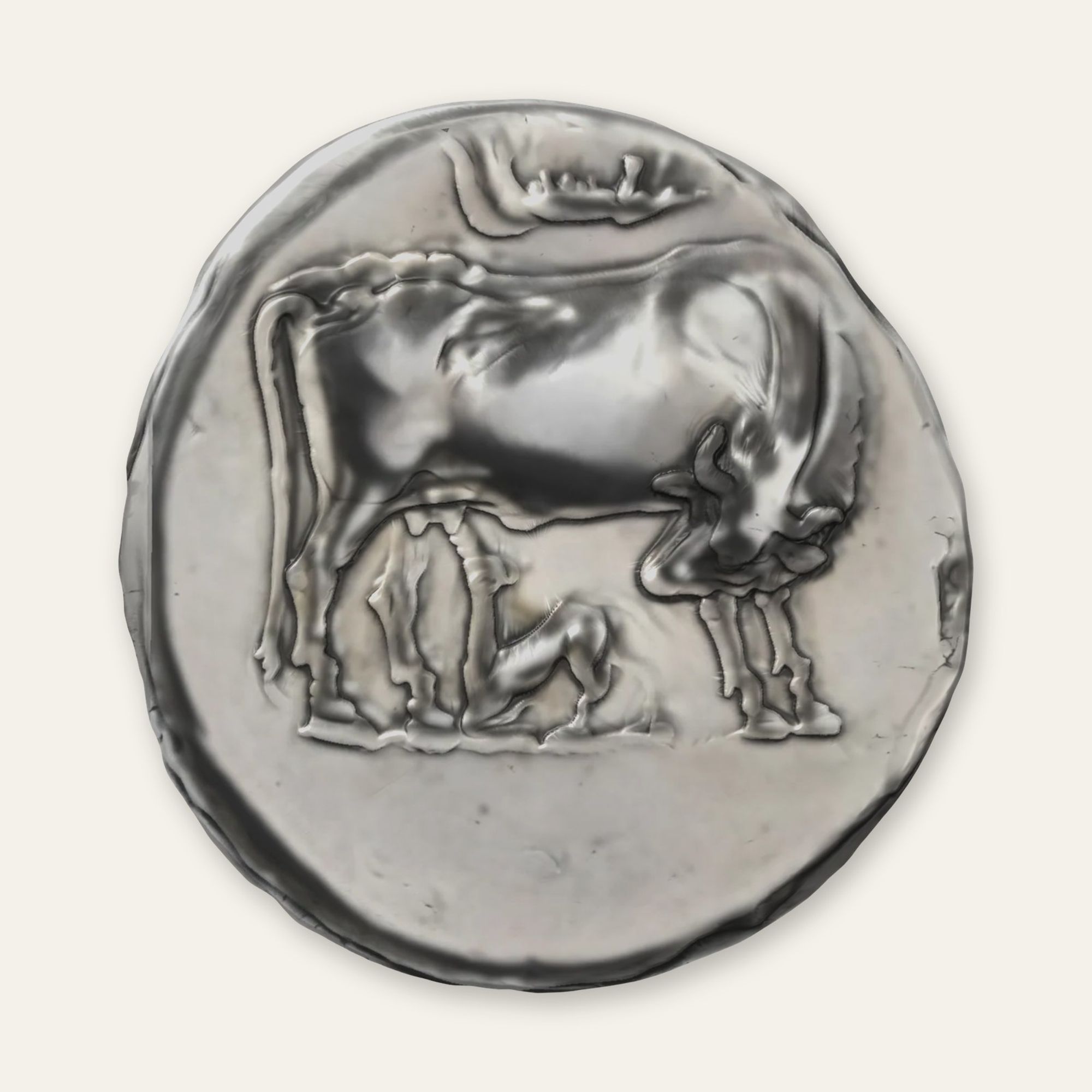
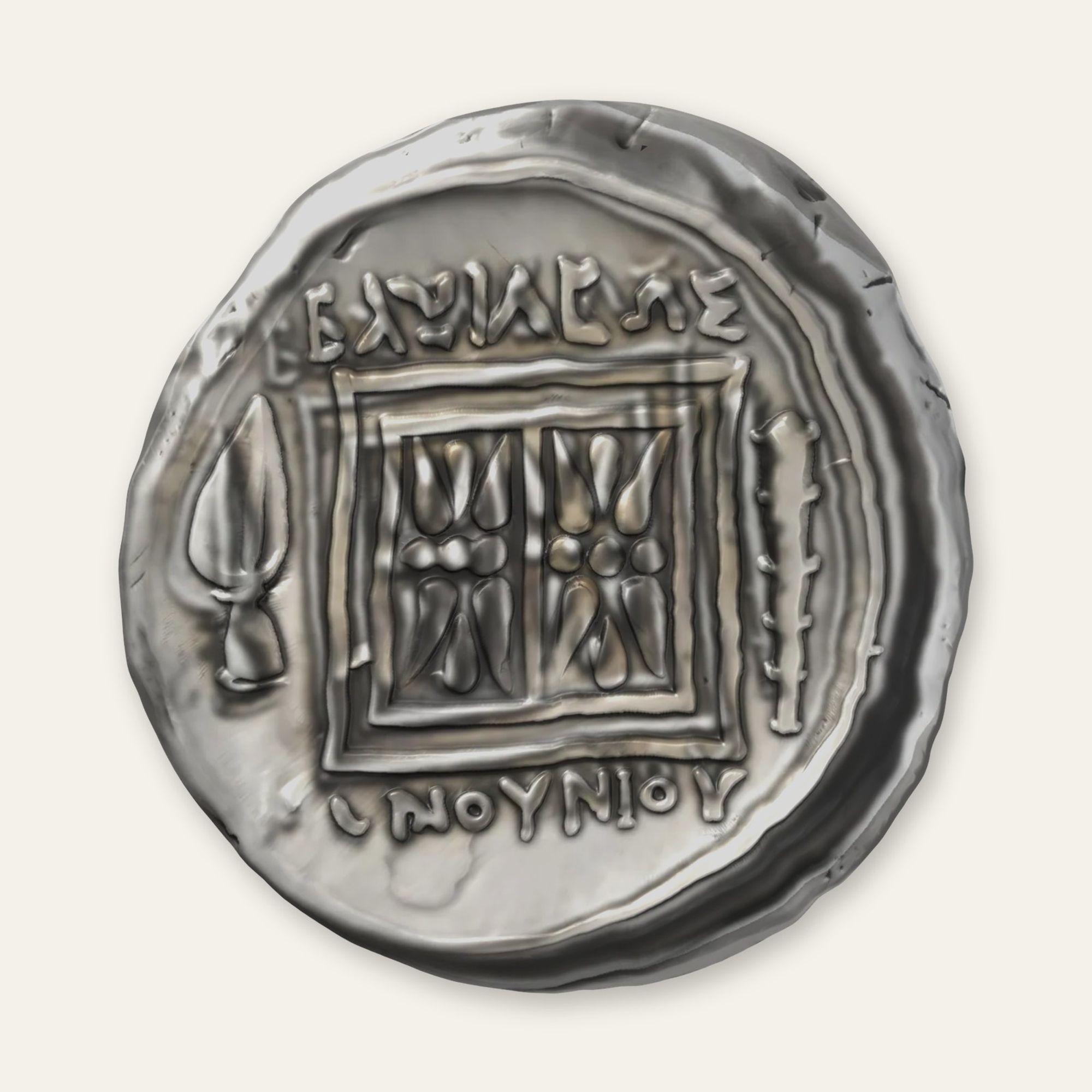
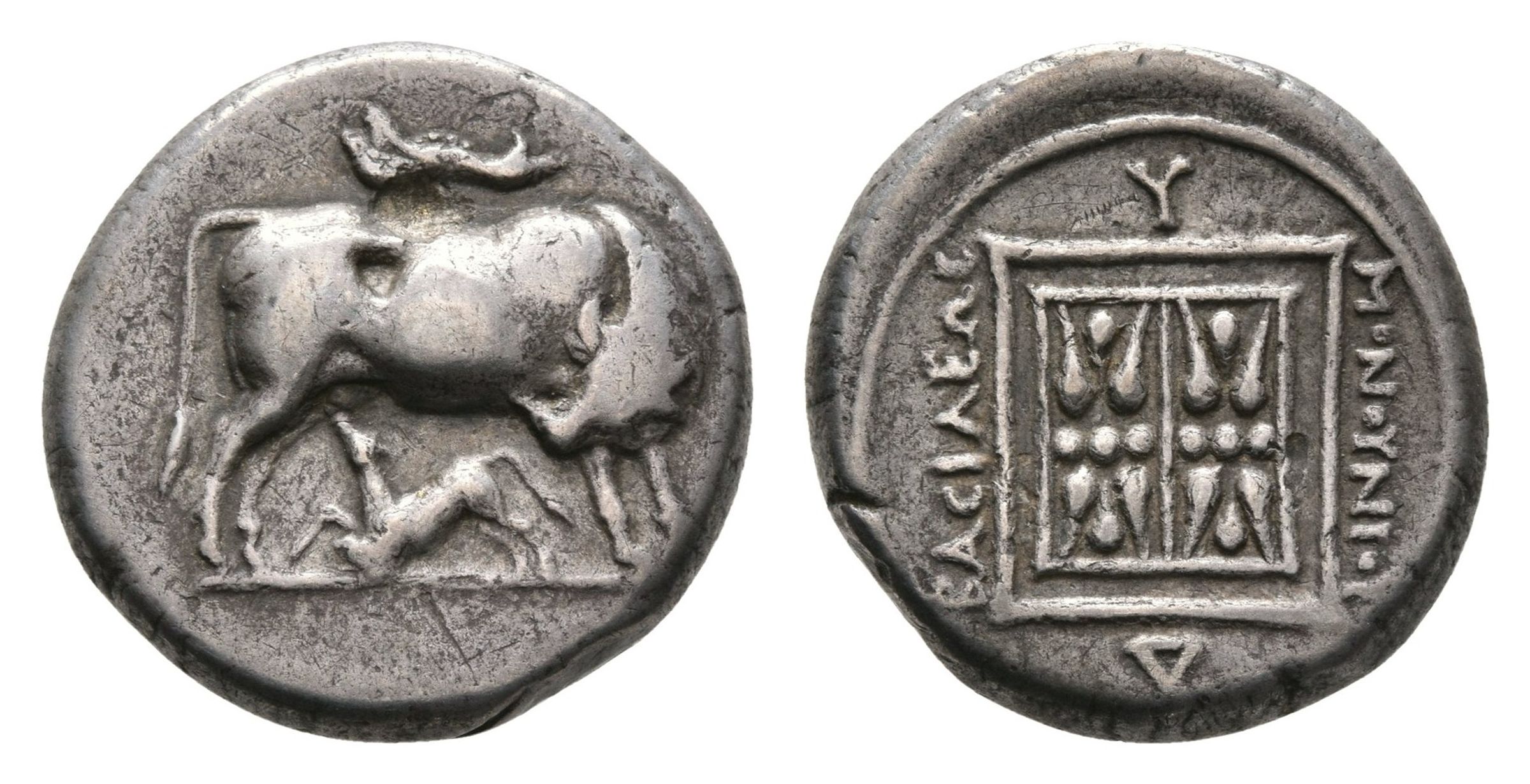
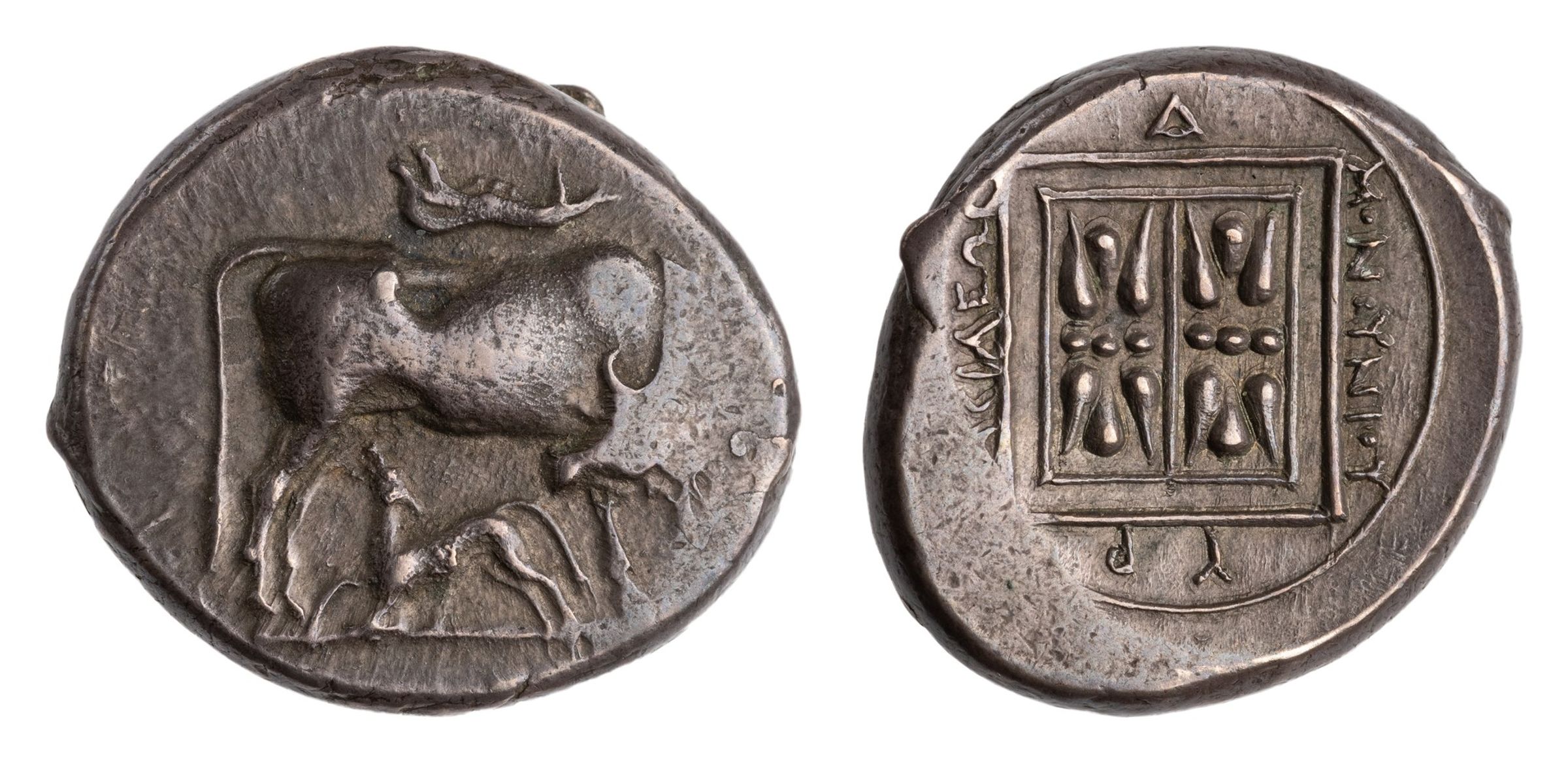
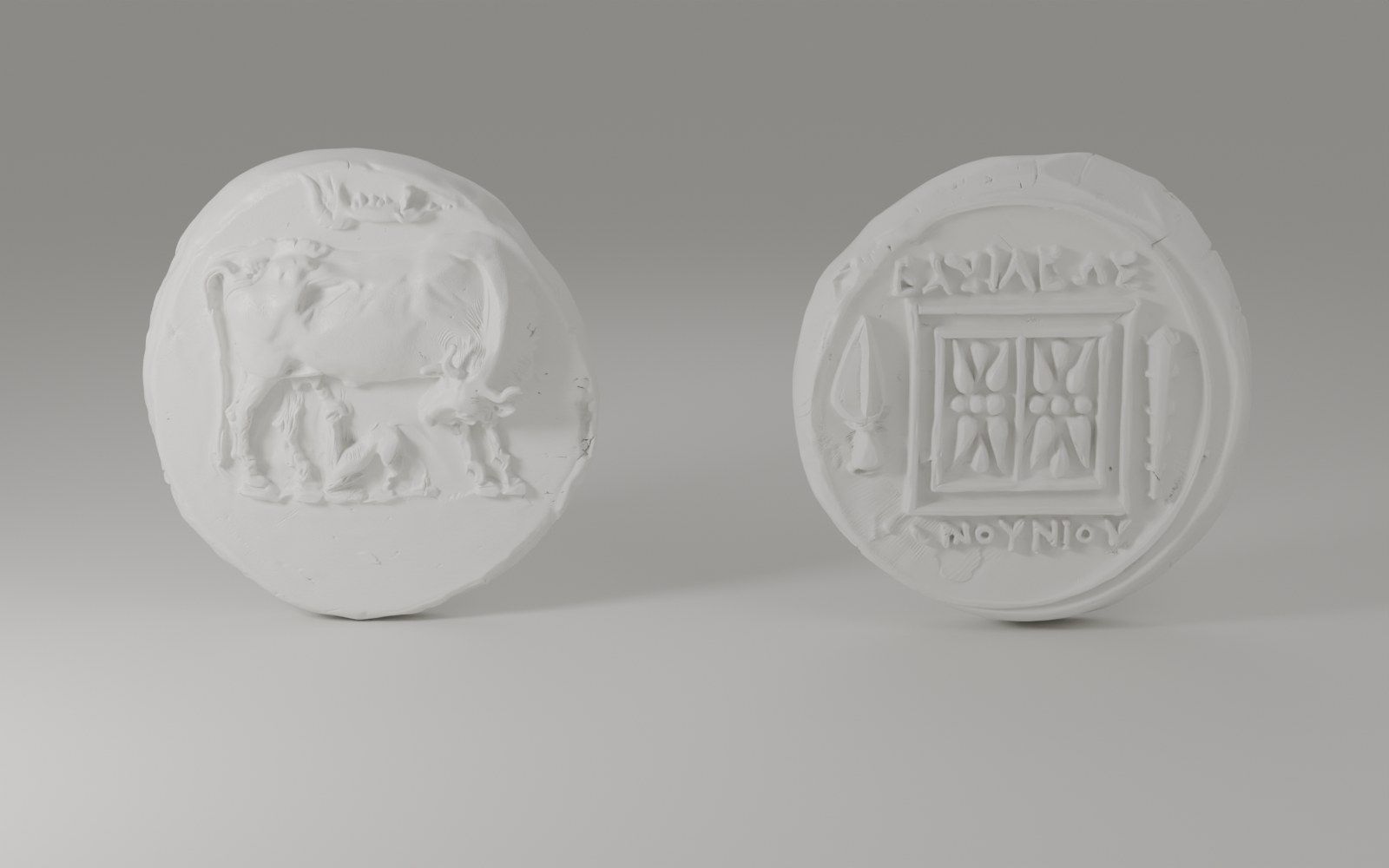
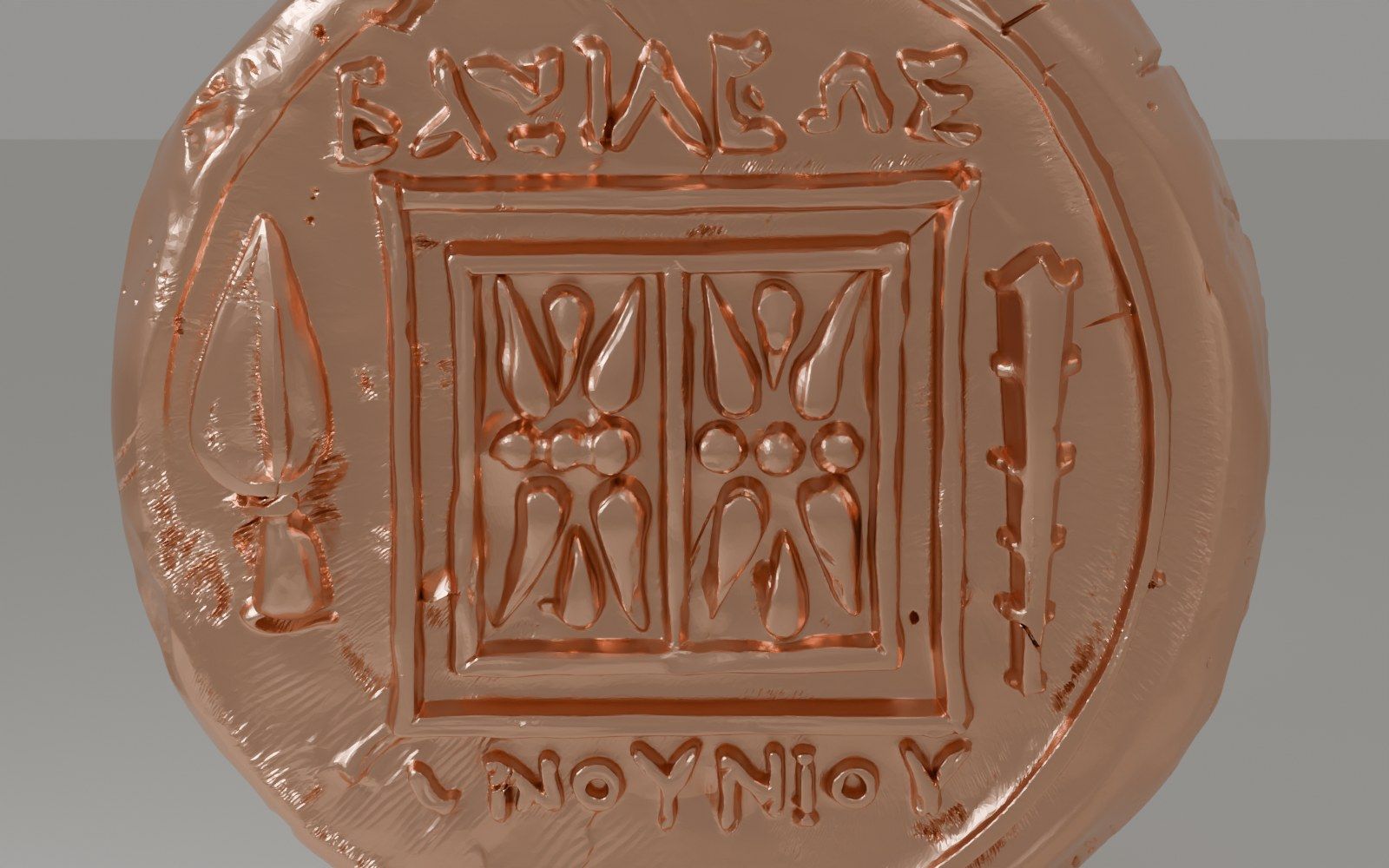
A silver stater of the Illyrian king Monounios, struck at Dyrrhachion, today Durrës in Albania. The obverse shows a cow suckling a calf, with part of a wild boar’s jaw above it; the reverse has a double star-shaped, or stylised floral, ornament in a square frame, with the legend ΒΑΣΙΛΕΩΣ ΜΟΝΟΥΝΙΟΥ — “of King Monounios”. His staters are also attested by the published Kreshpan hoard, which contained 45 coins of this royal issue.
The coin is broadly dated to the early 3rd century BC: the British Museum gives c. 300 BC, the University of Tübingen c. 280–270 BC.
The 3D model was made after photographs of a specimen of this type: obverse and reverse were modelled separately, in full relief, and joined into a two-sided coin at approximately true size (diameter after measured specimens of the type, thickness derived from the weight). The model is a faithful three-dimensional rendering of the type, not a measured survey of the specimen; the relief height is emphasised for legibility. For 3D printing, obverse and reverse were prepared as separate models.
The photographs of originals in the gallery come from public collections, under the licence each collection states; source and link are in the notes.12
Note (2)
- Source: photographs of the obverse and reverse, Institut für Klassische Archäologie, Universität Tübingen, ID3806 (SNG Tübingen 1508), photo: Stefan Krmnicek — https://www.ikmk.uni-tuebingen.de/object?id=ID3806. Licence: Public Domain Mark 1.0. ↩
- Source: photographs of the obverse and reverse, American Numismatic Society, New York, 1944.100.18588 — https://numismatics.org/collection/1944.100.18588. Licence: Public Domain Mark 1.0. ↩
Obverse and reverse
Obverse and reverse, rendered from the 3D model; metal colour and patina after photographs of the specimen.
Plates from the documentation
Replicas for 3D printing
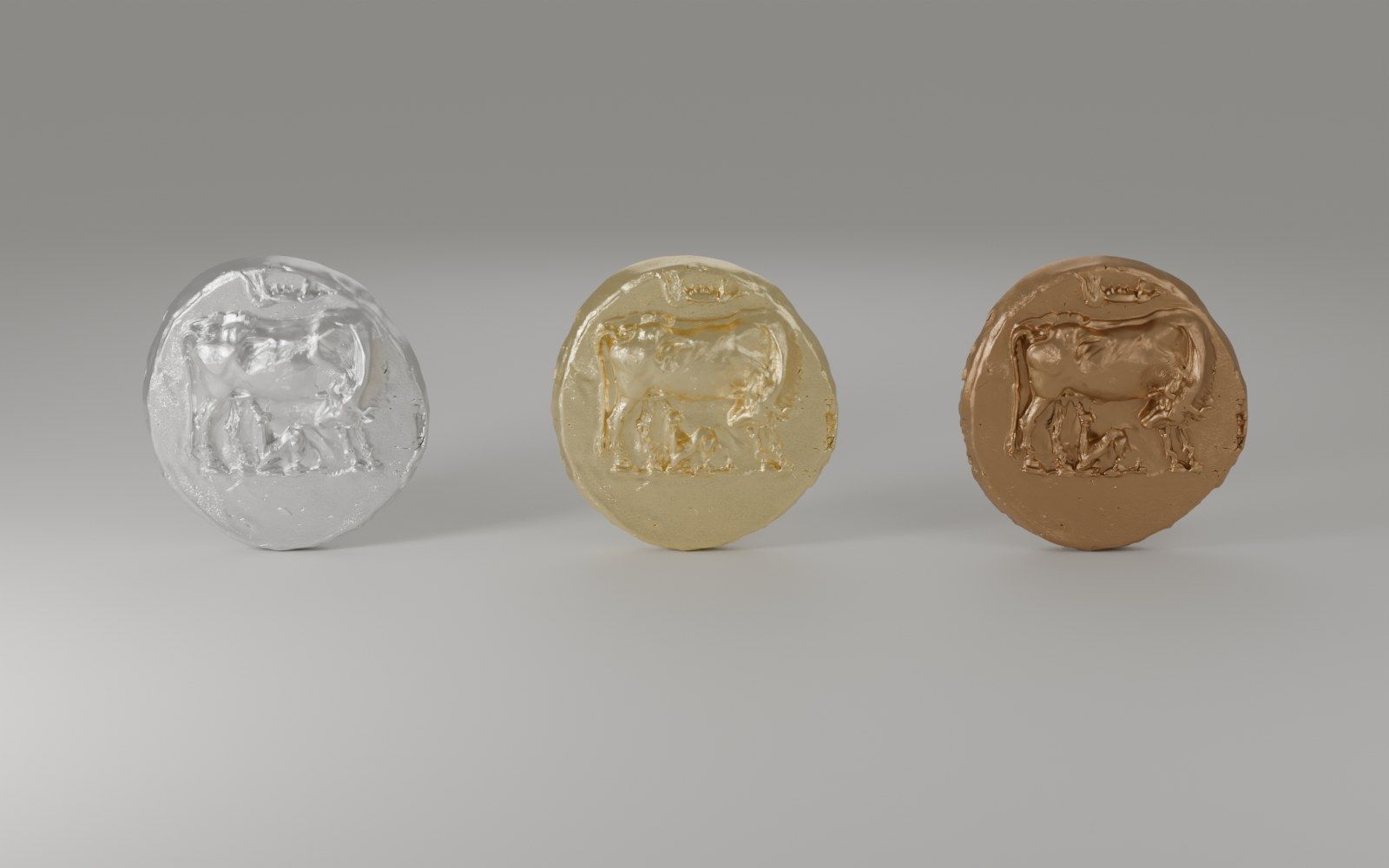
Renders of the 3D model in the proposed replica sizes and materials.
- Metal: bronze, copper, brass, silver, iron
- For objects made of metal: coins in bronze, copper and brass, the silver stater in silver, the helmet and the axe in bronze, brass and iron.
The texts, measurements and reconstructions on this site are the analysis of the project implementer (3DExperts) and do not represent the views of the Tourist Organisation of Ulcinj, the Centre for Culture Ulcinj or the Museum of Ulcinj. The findings and interpretations are to be confirmed by the competent institutions and specialists engaged in this research.
Literature and sources (4)
- Britanski muzej, primjerak 1866,1201.1408, ista varijanta kao model: lijevo od kvadrata vrh koplja, desno toljaga; 10,41 g — www.britishmuseum.org/collection/object/C_1866-1201-1408 (fotografija pod licencom CC BY-NC-SA, zato nije prenesena)
- SNG Tübingen 1508, Univerzitet u Tibingenu — www.ikmk.uni-tuebingen.de/object?id=ID3806
- Sh. Gjongecaj, „Le trésor de Kreshpan“, Revue numismatique 6/153 (1998), str. 81 — www.persee.fr/doc/numi_0484-8942_1998_num_6_153_2192
- Fotografija originala: American Numismatic Society, New York, 1944.100.18588 — numismatics.org/collection/1944.100.18588 (Public Domain Mark 1.0).
From the same collection
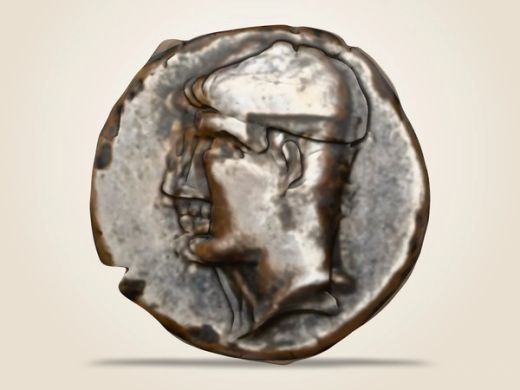
Coin of King Ballaios — Artemis with a torch
3rd century BC (c. 260/250–230) or 2nd century BC (after 168); dating disputed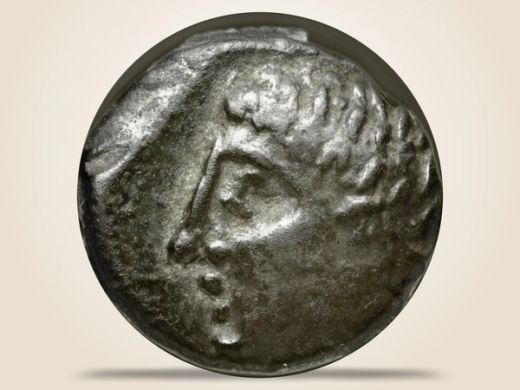
Coin of King Ballaios — Rhizon type (Risan mint)
2nd century BC, 167–135 per BnF; mid-3rd century BC per the Lexicon of the Archaeology of Montenegro (dating disputed)