Prehistoric ceramic female figurine
Praistorijska keramička figurina žene
Drag to rotate · scroll to zoomDrag to rotate · pinch to zoom
loads {mb} MBObjects that were not scanned but reconstructed: the Old Town as a 3D model from open spatial data and, from photographs, a side of the 9th-century ciborium (National Museum in Belgrade), the plaque with the IHS monogram in the Old Town, coins of Illyrian kings and cities, of medieval Ulcinj and Svač and of the Roman Empire, and finally an Illyrian-type helmet as a sample. A reconstruction is not identical to the original: shape, ornament and dimensions may differ. An exact model will come from 3D scanning the original, and for the town from a drone or lidar survey.
Description
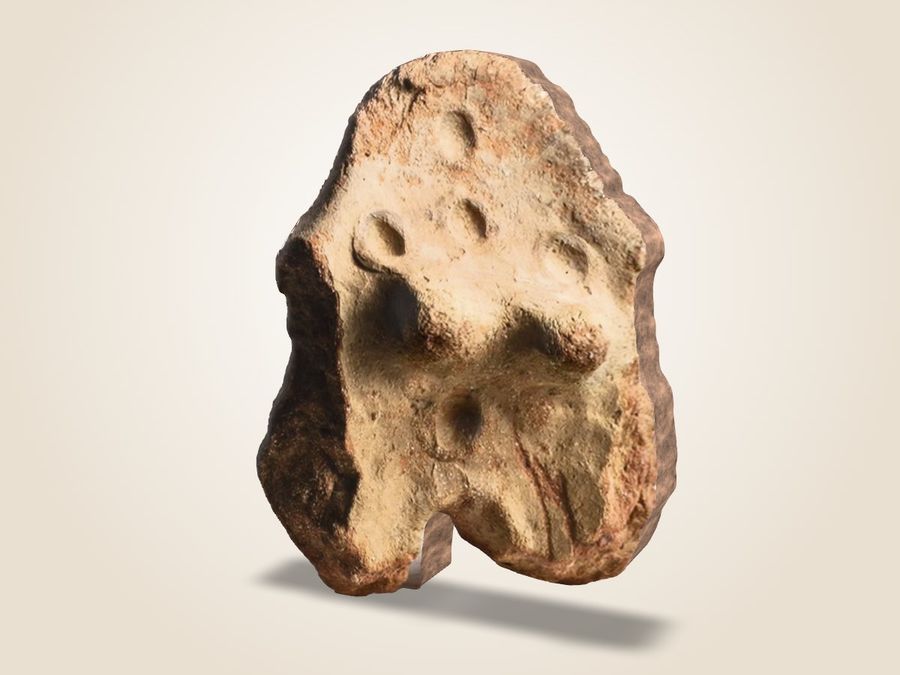
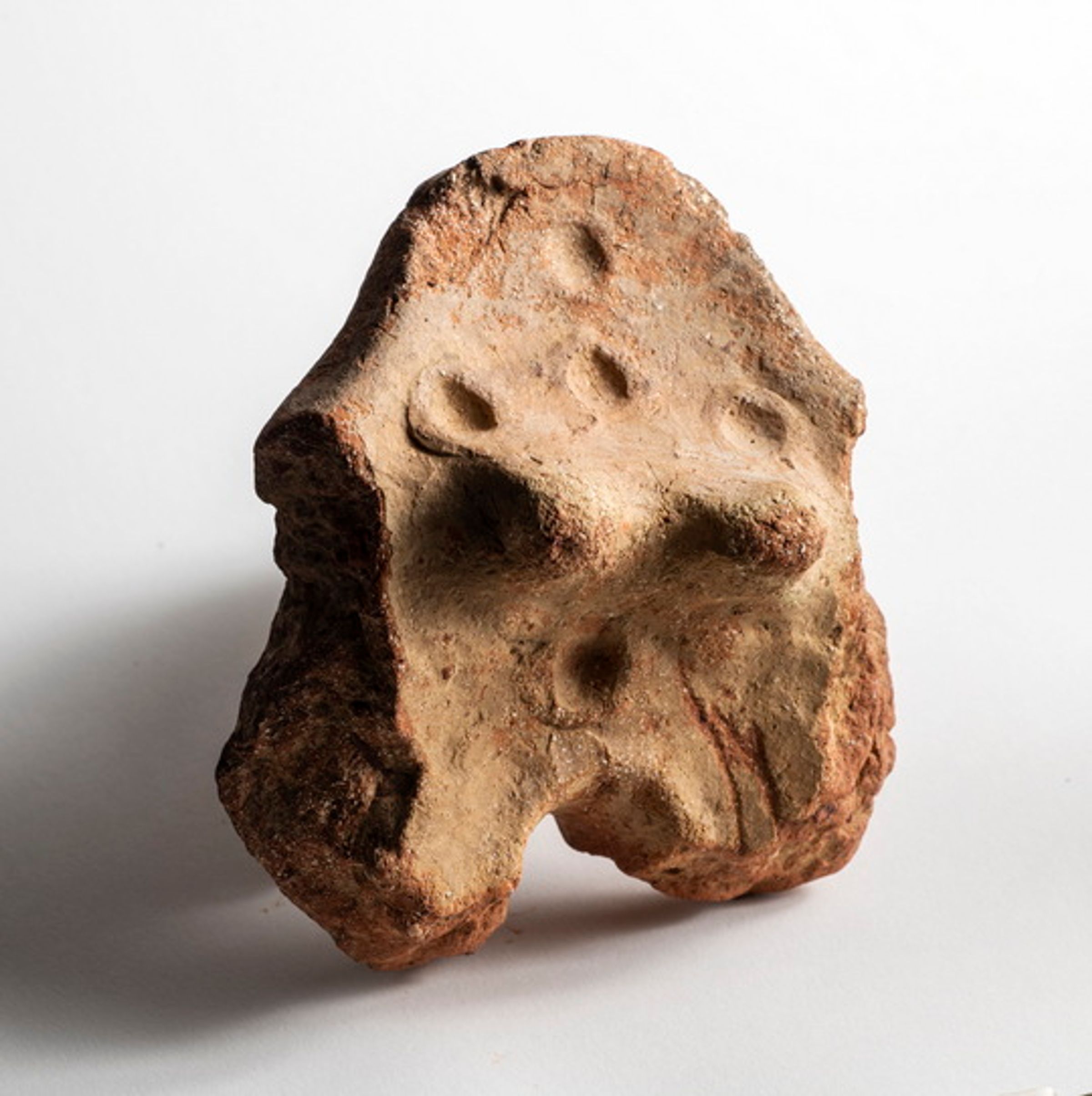
The upper part of a flat female figurine of fired clay, the oldest object in this collection. The surviving part is 14.7 cm high, 11.6 cm wide and 2.8 cm thick; the lower part and the sides are broken off.1 On the front are two breasts in relief, a larger depression below them, and on the rounded upper projection (the “head”) three shallow depressions in a row and one above them. On the lower fracture line half of a small, carefully drilled round hole can be seen, interpreted as a female sexual symbol.2 The other side is flat.4
The figurine is made of clay fired at a high temperature with crushed limestone, and the front was coated with a greyish-white paint. When it was entered in the inventory it was described as a “fragment of a vessel (?)”; only when it was taken out for a display case was it noticed that it represents a woman.1
Where it was found
It was found in 1969 on the citadel of the Old Town, in a trench next to the Illyrian-Greek wall (structure 221), 2.05 m below the threshold of the Museum; it was entered in the Museum inventory on 19 November 1969 under number 1449.1 Maja Parović-Pešikan associates it with the deepest, undisturbed prehistoric layer, directly above the bedrock.2 Pavle Mijović warns that after 1718 earth with rubble from the nearby gardens was dumped into this area, so the layer is not reliable, and Čedomir Marković thinks the figurine probably arrived with rubble from a nearby prehistoric site.13 The Lexicon of Archaeology of Montenegro notes that such finds led researchers to think that the rock itself may have been settled in prehistory.4 The question remains open.
Date
There are no direct analogies. Parović-Pešikan connects it with monuments of the Late Eneolithic and the beginning of the Early Bronze Age: with the violin-shaped idols of the Cycladic Grotta-Pelos culture, of Anatolia and of the sites of Shtoj near Shkodër and Maliq in Albania, and with disc-shaped idols with a central hole. She concludes that the Ulcinj idol preserves an eastern Mediterranean tradition, known from pottery from Troy and the silver idol from Amnisos on Crete, rather than being related to idols from the Carpathian-Danube basin.2 The Lexicon of Archaeology dates it broadly to the Eneolithic or Early Bronze Age and stresses that it differs from the violin-shaped idols of the Lake Skadar basin.4
What it was for
Mijović sees in it a goddess of breastfeeding and calls it the “Diva Rumina of Ulcinj”, after the Italic goddess of nursing; he reads the depressions as eyes, nose and mouth pressed in with a finger. He himself concludes that the figure is “morphologically original” and leaves the problem open.1 Marković reports this as one opinion and adds that there is nothing to help define the cult more precisely.3 It is therefore named here descriptively, not after a goddess.
The 3D model
The figurine was not recorded for this project. The model was made from a single published photograph (© CANU, Lexicon of Archaeology of Montenegro), but unlike most photo-based models it is to scale: width, height and thickness follow the published dimensions.1 The outline, the colour of the front and the layout of the depressions come from the photograph; the height of the breasts and the depth of the depressions are estimates. The sides and the back were not photographed: the back is flat, as described, and the colour of the fracture was taken from the edge of the photograph.
Note (4)
- P. Mijović, “Ulcinjski triptih kultne plastike” (The Ulcinj triptych of cult sculpture), Glasnik Odjeljenja umjetnosti CANU 14, Podgorica 1995, 44–55: “The ceramic sculpture with the figure of a woman was found in a trench next to structure 221, at a depth of 2.05 m below the datum (the threshold of the Museum in the Old Town); it is largely damaged and now measures 14.7 × 11.6 / 2.8 cm (Inv. no. 1449, of 19 Nov 1969).” The English summary of the same paper gives the excavation as 1966; the year from the inventory is kept here. ↩
- M. Parović-Pešikan, “Antropomorfna plastika iz Ulcinja” (Anthropomorphic sculpture from Ulcinj), Glasnik Odjeljenja umjetnosti CANU 16, Podgorica 1997, 5–15: the surviving part is about 14 cm high and its thickness increases noticeably downwards; on the lower fracture line “a small round hole, carefully drilled”; found in the deepest horizon, “directly above the rocks and between them”. Fig. 1 (photograph) and fig. 2, 1 (drawing). ↩
- Č. Marković, “Kultni predmeti i simboli iz praistorije Crne Gore” (Cult objects and symbols from the prehistory of Montenegro), Arhivski zapisi 1/2014, 9–33, here 23–25: the figurine “probably arrived with rubble brought from a nearby prehistoric site, which was used to fill and level parts of the citadel”. ↩
- CANU, Lexicon of Archaeology of Montenegro, entry “Ulcinj”: “The object is flat on one side, while on the other it has several depressions arranged crosswise, and protrusions considered to be breasts”; photo caption: “Ceramic figurine, Eneolithic / Early Bronze Age, Local Museum Ulcinj”. ↩
Technical drawing
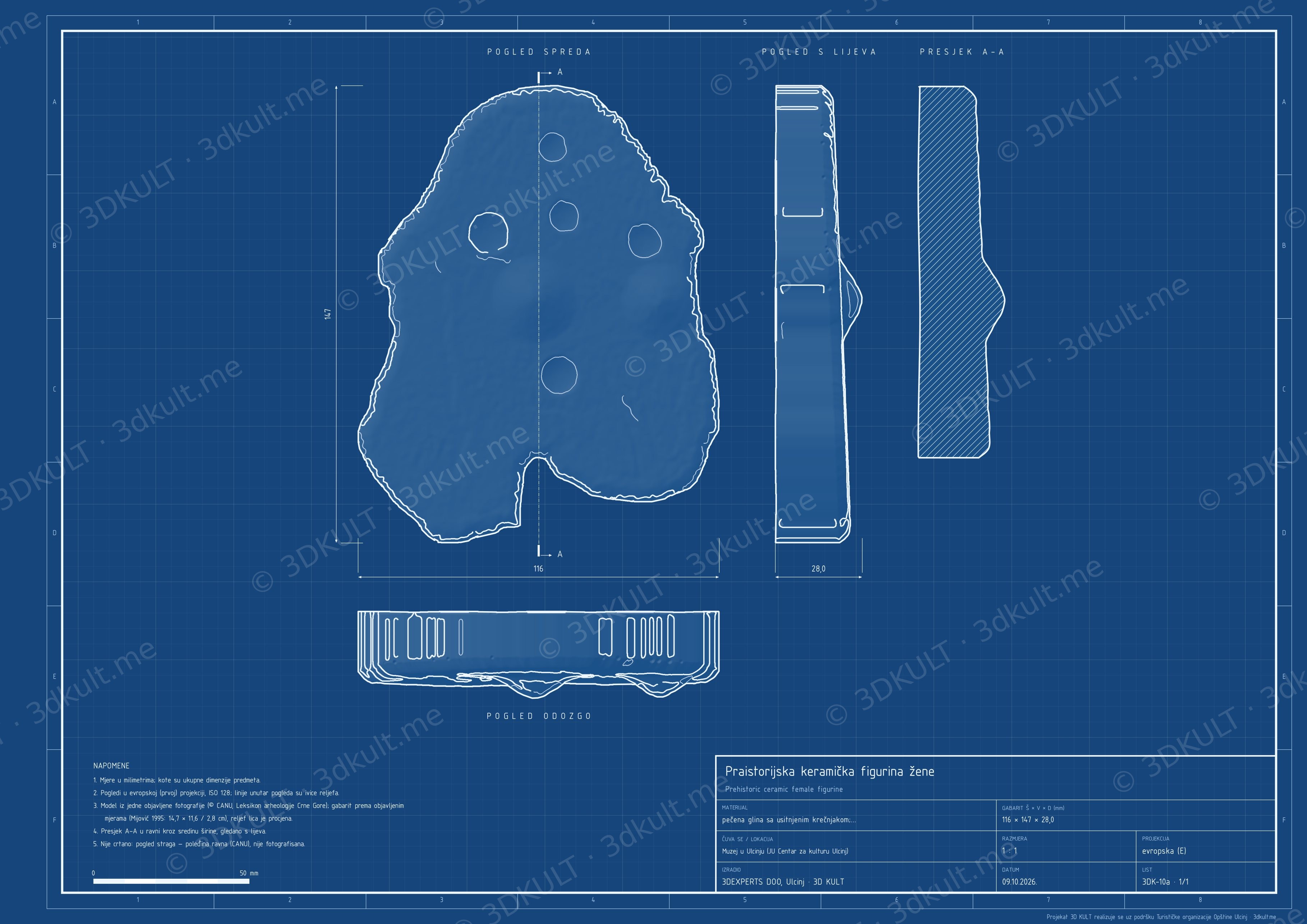 Open PDF (A3) ↓
Plates from the documentation
The texts, measurements and reconstructions on this site are the analysis of the project implementer (3DExperts) and do not represent the views of the Centre for Culture Ulcinj, the Museum of Ulcinj or the Tourist Organisation of Ulcinj. The findings and interpretations are to be confirmed by the competent institutions and specialists engaged in this research.
Literature and sources (5)
- P. Mijović, Ulcinjski triptih kultne plastike, Glasnik Odjeljenja umjetnosti CANU 14, 1995 — canupub.me/dln2
- M. Parović-Pešikan, Antropomorfna plastika iz Ulcinja, Glasnik Odjeljenja umjetnosti CANU 16, 1997 — canupub.me/en1u
- Č. Marković, Kultni predmeti i simboli iz praistorije Crne Gore, Arhivski zapisi 1/2014 — dacg.me/wp-content/uploads/2019/04/Arhivski-broj-1-za-2014.pdf
- CANU, Leksikon arheologije Crne Gore, odrednica „Ulcinj“ — leks.canu.ac.me/web/arhcg.php?OID=7115
- CANU, Leksikon arheologije Crne Gore, fotografija figurine — leks.canu.ac.me/web/Slike/Fig-ARHCG-7115-8173.jpg