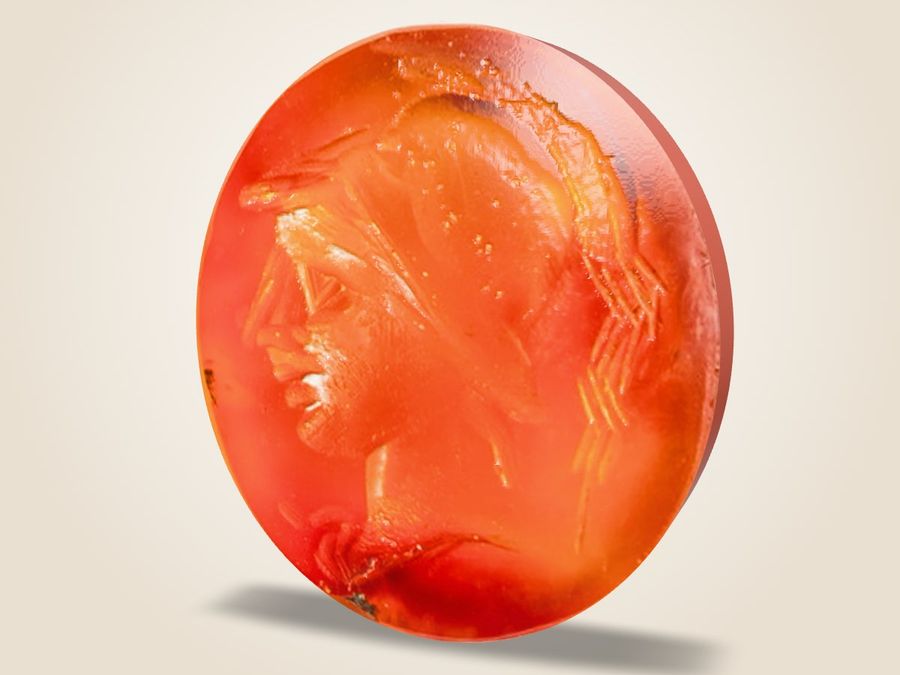
Engraved gem with the head of Athena
Gema sa predstavom Atene
Drag to rotate · scroll to zoomDrag to rotate · pinch to zoom
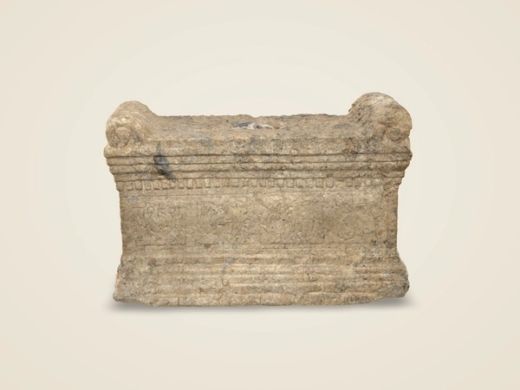
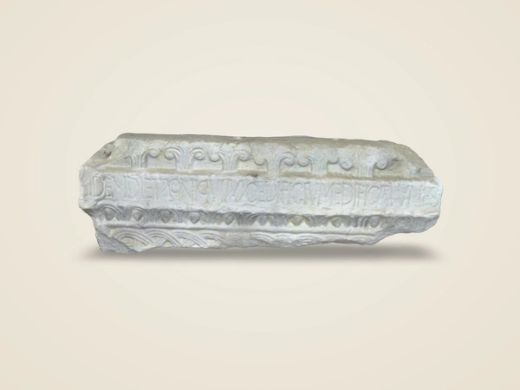
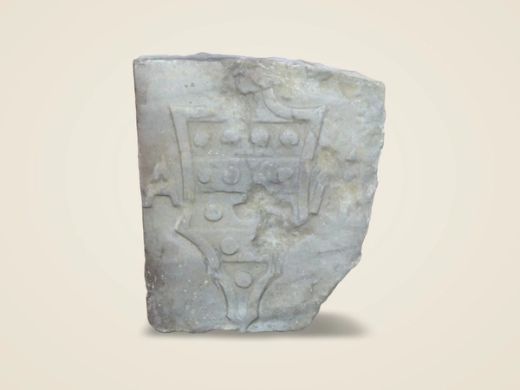
loads {mb} MBObjects that were not scanned but reconstructed: the Old Town as a 3D model from open spatial data and, from photographs, a side of the 9th-century ciborium (National Museum in Belgrade), the plaque with the IHS monogram in the Old Town, coins of Illyrian kings and cities, of medieval Ulcinj and Svač and of the Roman Empire, and finally an Illyrian-type helmet as a sample. A reconstruction is not identical to the original: shape, ornament and dimensions may differ. An exact model will come from 3D scanning the original, and for the town from a drone or lidar survey.
Description
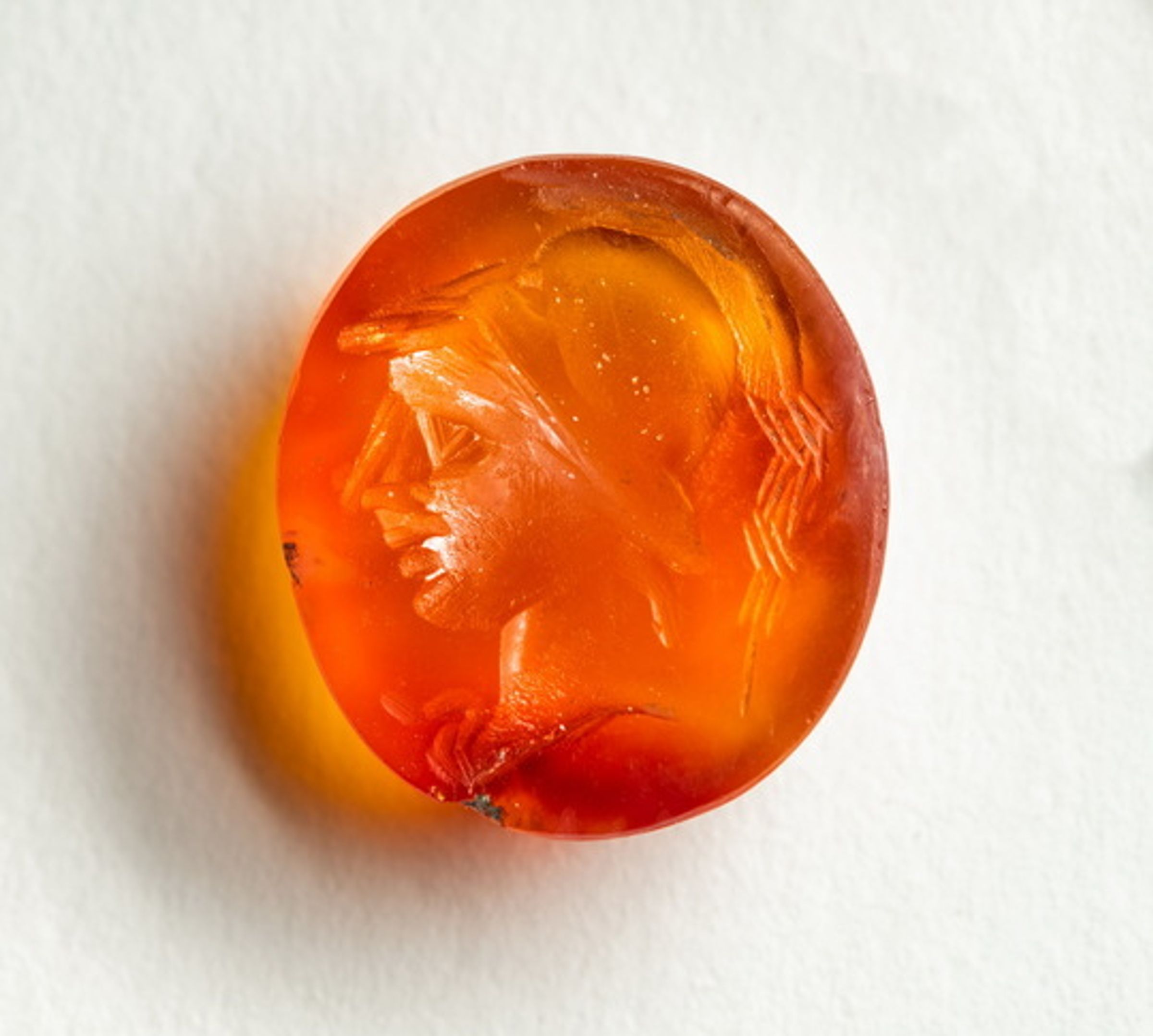
A small engraved gem of translucent orange-red stone with the head of the goddess Athena in profile, facing left and wearing a helmet. The image is cut into the stone (intaglio): pressed into wax or clay, the gem leaves a raised image facing right. Gems of this kind were usually set in rings and served as personal seals, ornaments or amulets.
The gem was found during archaeological research in the Old Town, near the preserved ancient wall on the citadel, in the same area as fragments of Illyrian and imported Hellenistic pottery.1 It is kept in the Museum in Ulcinj. The kind of stone, its dimensions and the year of discovery have not been published.
Date
The sources disagree. The Lexicon of Archaeology of Montenegro dates the gem to the 4th–3rd century BC in its entry on Ulcinj and to the 3rd century BC in the photo caption; the Lexicon of Fine Arts of Montenegro mentions “a gem from the 5th century”.2 The range from the archaeological entry is given here as the most direct description of the find.
A gem, not a cameo
Pavle Mijović's 1985 guide and tourist descriptions call it an ancient cameo.3 A cameo, however, is a relief standing out of the stone; here the image is cut in, so the correct term is gem (intaglio), as the Montenegrin Academy of Sciences and Arts calls it.
Lost and recovered
Mileva Nikolaidis, later director of the Museum, said in 2015 that she found the gem as an archaeology student during excavations in Ulcinj. The Museum opened in 1975, and in the 1979 earthquake the building collapsed and part of the collection was lost. When she started working at the Museum in 1984, the gem was the first thing she looked for. A large part of the museum material was found with a person in Ulcinj and returned with the help of the police; the gem is now on permanent display.4
The 3D model
The gem was not recorded for this project. The model was made from a single published photograph (© CANU, Lexicon of Archaeology of Montenegro): outline and colour come from the photograph, and the cuts of the image were estimated from the brightness of the engraved surfaces. The depth of the cuts, the curvature and the thickness of the stone are estimates, and the true size has not been published, so the model is not to scale. From the back the image shows through mirrored, as through translucent stone.
Note (4)
- CANU, Lexicon of Archaeology of Montenegro, entry “Ulcinj” (M. Vrzić, A. Ljuljđuraj): “Among the movable finds discovered near the preserved ancient wall, a gem with an engraved portrait of the goddess Athena wearing a helmet stands out, dated to the 4th–3rd century BC.” ↩
- Same lexicon, photo caption: “Gem with the image of Athena, 3rd century BC, Local Museum Ulcinj”. CANU, Lexicon of Fine Arts of Montenegro, entry “Ancient art”: “Fragments of black-figure vases and white lekythoi with red paint were found, as well as a gem from the 5th century.” ↩
- P. Mijović, Ulcinj — a historical and art guide, 3rd edition, Museum Ulcinj, 1985: a photograph captioned “Museum Ulcinj, ancient gem” and, in the description of the collection, “an ancient pedestal with a Greek inscription dedicated to the goddess Artemis, and an ancient cameo”. ↩
- Portal Analitika, “Ulcinj Museum: you work with treasure and feel worthless”, 27 Feb 2015, statement by Mileva Nikolaidis. The year of discovery and the date of recovery are not given. ↩
Technical drawing
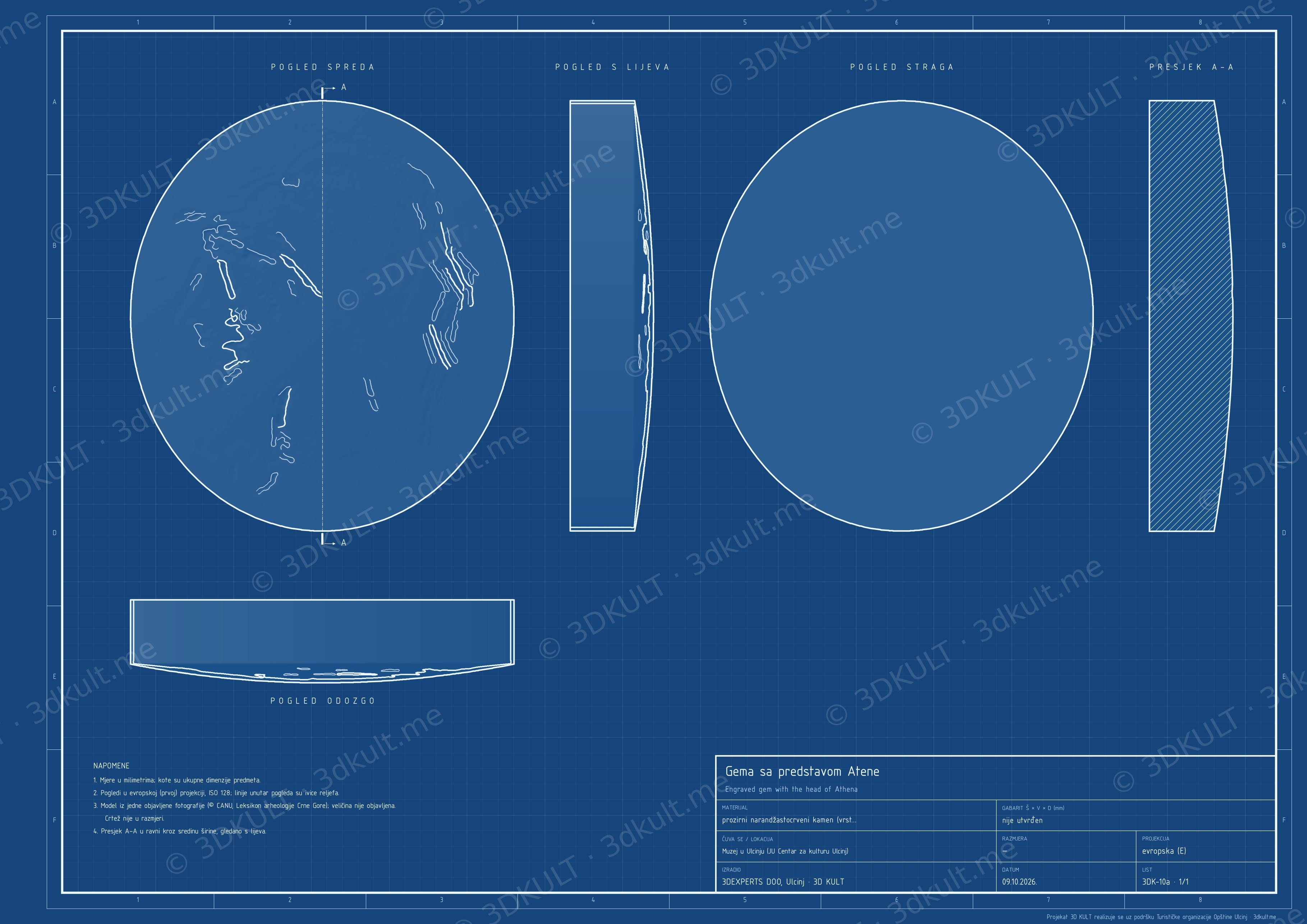 Open PDF (A3) ↓
Plates from the documentation
The texts, measurements and reconstructions on this site are the analysis of the project implementer (3DExperts) and do not represent the views of the Centre for Culture Ulcinj, the Museum of Ulcinj or the Tourist Organisation of Ulcinj. The findings and interpretations are to be confirmed by the competent institutions and specialists engaged in this research.
Literature and sources (5)
- CANU, Leksikon arheologije Crne Gore, odrednica „Ulcinj“ — leks.canu.ac.me/web/arhcg.php?OID=7115
- CANU, Leksikon arheologije Crne Gore, fotografija geme — leks.canu.ac.me/web/Slike/Fig-ARHCG-7115-7299.jpg
- CANU, Leksikon likovne umjetnosti Crne Gore, odrednica „Antička umjetnost“ — leks.canu.ac.me/web/llucg.php?OID=4472
- P. Mijović, Ulcinj — istorijsko-umjetnički vodič, 3. izd., Muzej Ulcinj 1985 — www.vodic.dlib.me/fajlovi/p1hhkk7ae216h819emuk91cs11k1a4.pdf
- Portal Analitika, 27. 2. 2015 — www.portalanalitika.me/clanak/178027--ulcinjski-muzej-radis-sa-blagom-a-osjecas-se-bezvrijednim