Fragment of the Ulcinj ciborium
Ulomak ulcinjskog ciborijuma
Drag to rotate · scroll to zoomDrag to rotate · pinch to zoom
loads {mb} MBDescription
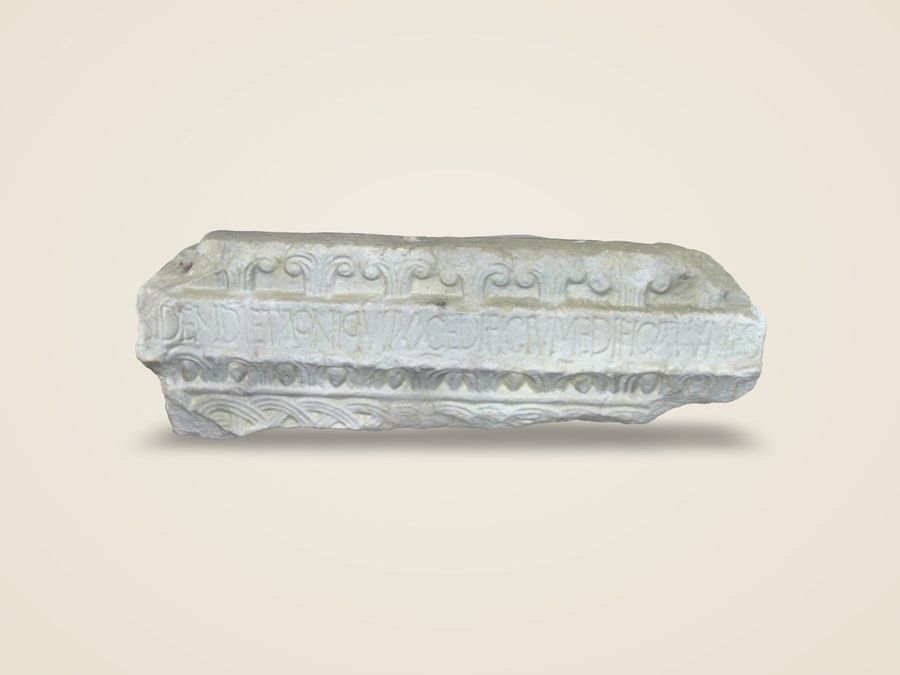
A stone fragment of the upper band of one side of a ciborium — the four-arched stone canopy that stood over the altar of an early medieval church in the Old Town of Ulcinj, of the 9th century. The ciborium was broken up long ago and its fragments are scattered from Ulcinj to Belgrade. This one was 3D-scanned: the scan measured the fragment, the depth of the inscription's letters and the fragment's place on its side of the ciborium.1
3D scan
The object was recorded by contact-free 3D scanning. The source model has 1.1 million triangles, with an average triangle edge of about 0.98 mm: the finest measure of shape the model retains. The surface colour was captured in an 8,192 × 8,192 pixel texture, about 6.1 pixels per millimetre of surface. The mesh is closed, so both its surface area, 4,656.1 cm², and its volume, 13,866.4 cm³, were measured. For the web the model was reduced to 150,000 triangles and a 2,048-pixel texture; the source scan is kept for documentation, technical drawings and printing replicas.
Church and dedication
It is not certain which church in Ulcinj the ciborium belonged to. It is thought to come from a single-nave early medieval church above the southern town gate, on whose site a new church was built in the 13th century, later destroyed under Ottoman rule.2 According to the reconstruction of the inscription, the ciborium was dedicated to Christ the Saviour.3
What it looked like
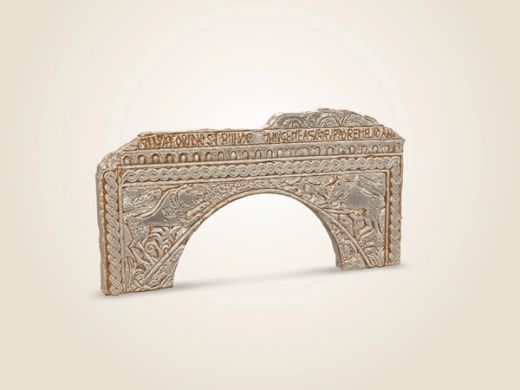
The ciborium was four-sided, with a roof in the form of a four-sided pyramid. On the front, two lions face each other, the right one chasing a smaller animal; the space beneath them is filled with palms. The arch is decorated with an interlaced triple band, the panel is framed by a plait with "eyelets", and along the cornice runs a frieze of ovolos and small arches, above which the inscription is carved in rustic capitals, without spaces between words.4 Its closest relatives are the ciboria of Kotor, Komolac and Dubrovnik.5 The ciborium was of marble; it is thought to be the work of the Kotor stonemasons' workshop, made shortly after the younger ciborium of the Cathedral of St Tryphon in Kotor, that is, after 809. Its fragments were found in a 9th-century pre-Romanesque church in the lower town, and pieces were built into several buildings of the Old Town as building stone.6
Guzma, the Holy Saviour and two emperors
The ciborium is a votive gift. It was erected by a woman named Guzma, pro remedio animae — for the salvation of her soul; her husband, whose name cannot be read on the surviving fragments, carried out her wish. The inscription also names two emperors, Leo and Constantine, and the ciborium is dated by them. The more widely accepted reading is Leo V and his son and co-emperor Constantine, which places the ciborium in 813–820; more recent interpretations also allow Leo III and Constantine V (720–741).7
The side in Belgrade
The largest fragment, a whole side with the arch and the lions, was taken around 1937 to the National Museum in Belgrade, where it is still kept; the other surviving fragments are in the Museum of Ulcinj.8 That side exists in this collection as a separate model, reconstructed from photographs.
This fragment
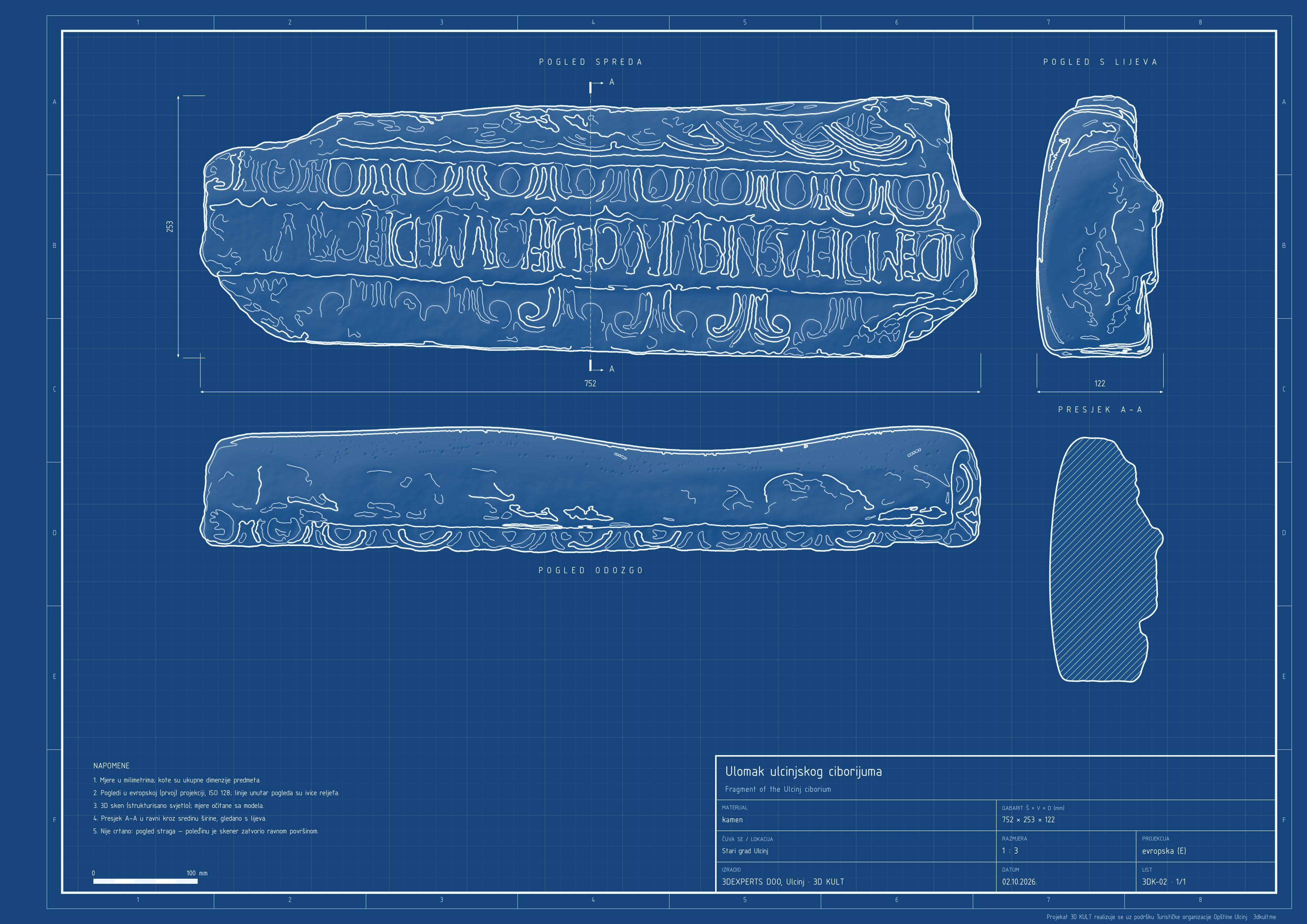
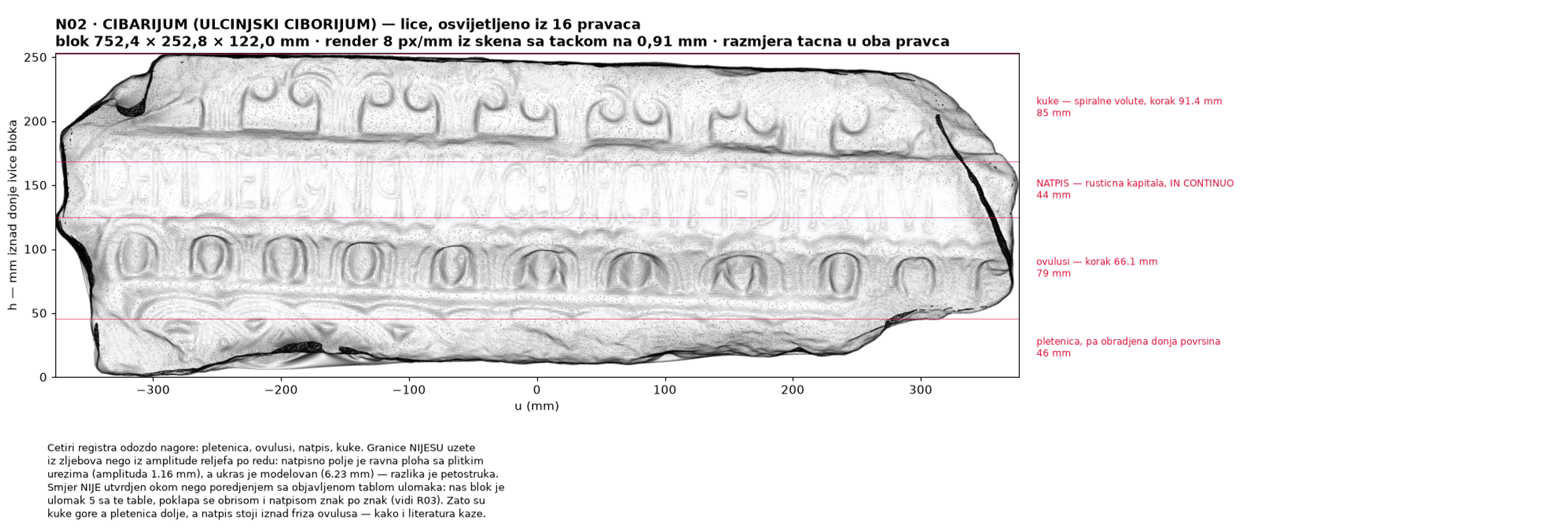
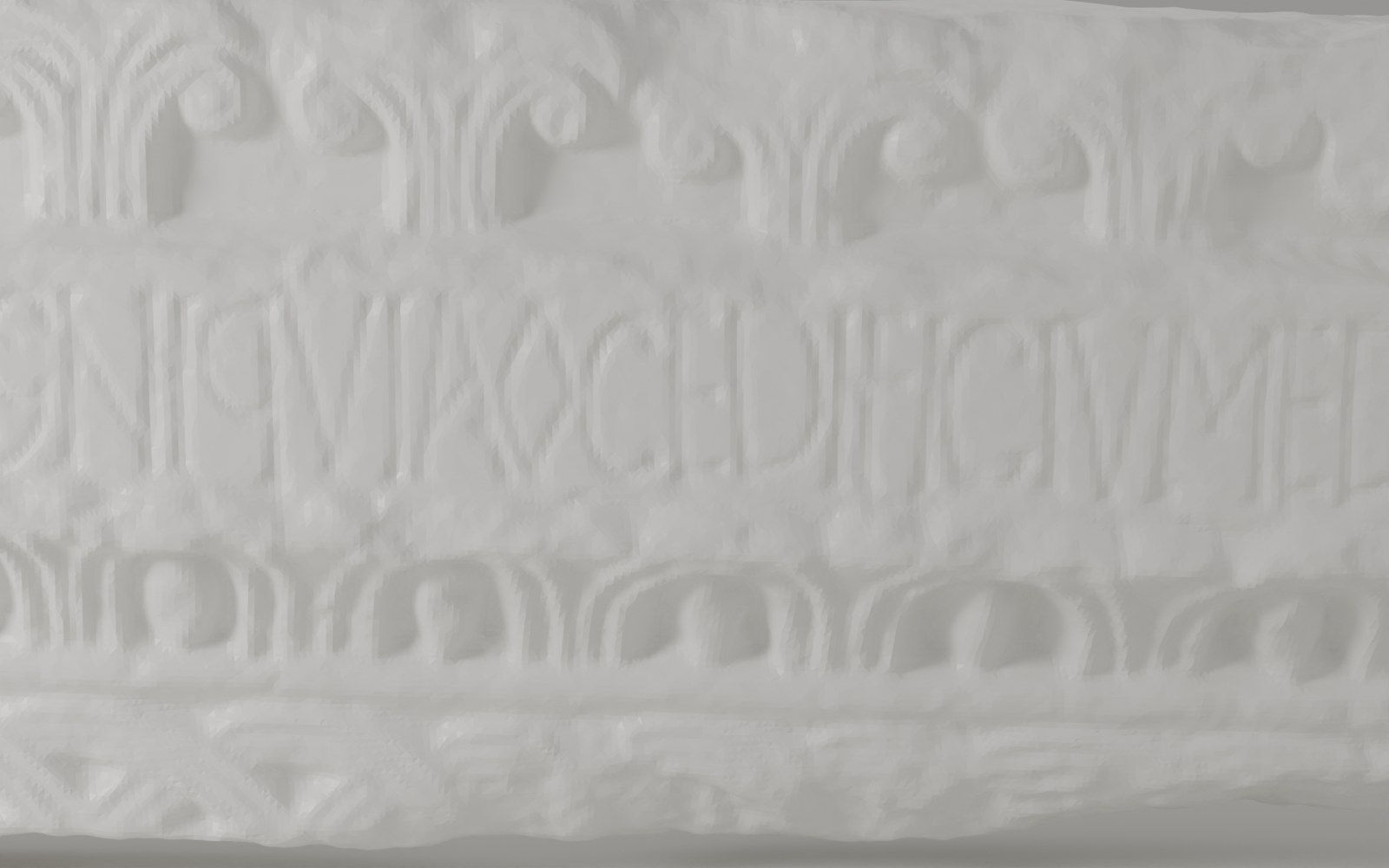
The fragment is 752 mm long, 253 mm high and 122 mm thick. On its face four bands run from top to bottom: crockets (paired spiral volutes), the inscription, a frieze of ovolos and a plait. Both ends are breaks; the underside is dressed flat, unlike the breaks; the back is only roughly dressed, since it was not meant to be seen.9
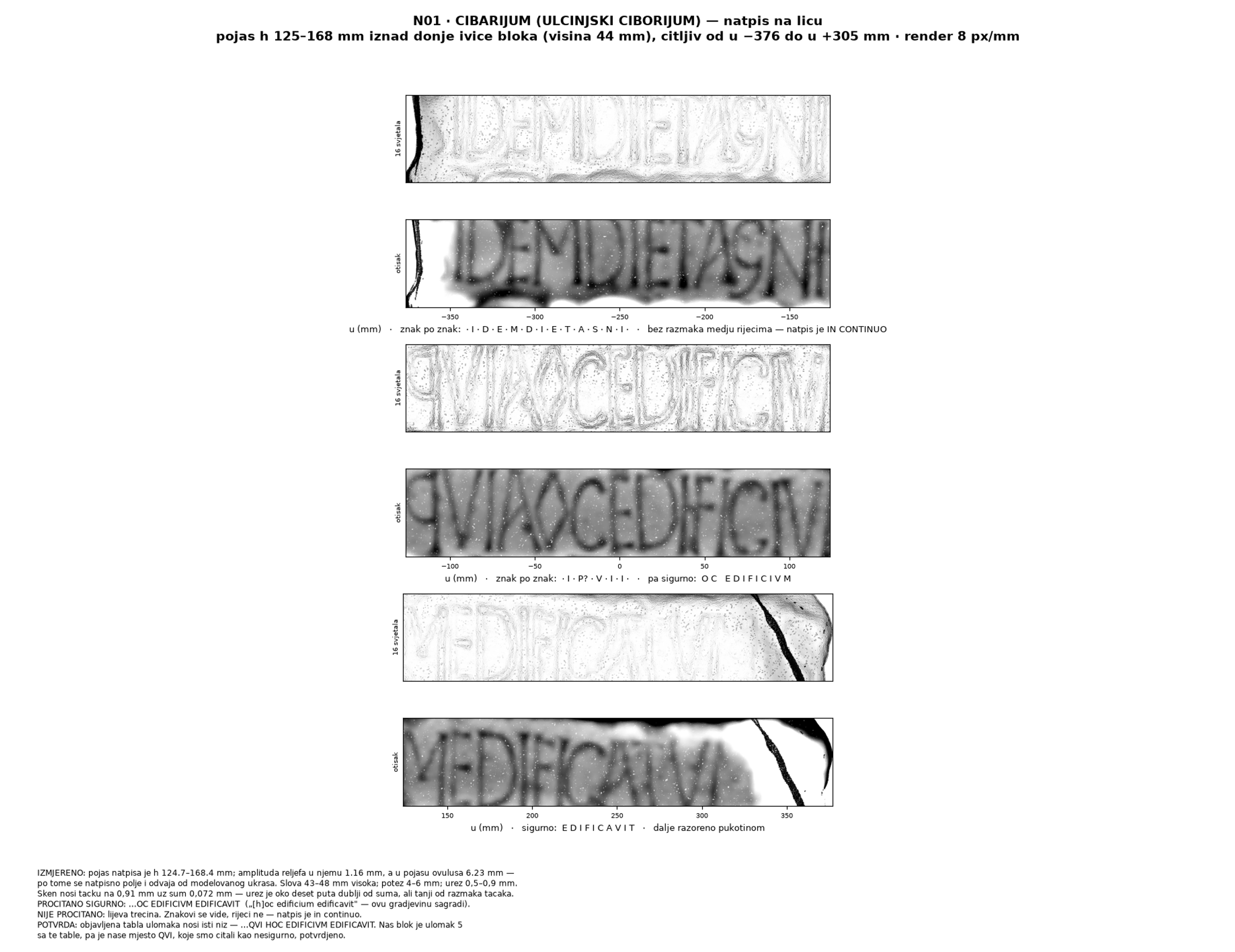
The letters of the inscription are 43–48 mm high but cut only 0.5–0.9 mm deep — at the very limit of what the scan records. On the published photograph of the same fragment the inscription is visible to the naked eye along its whole length; on the scan, lit virtually from sixteen directions, it reads …OC EDIFICIVM EDIFICAVIT, "[who] built this building".1011 The crockets at the top repeat every 91.4 mm; fifteen such steps give a side of 1.37 m, which agrees with the published plate of the fragments to within one per cent. On that plate the word QVI also stands before these words.12
The reconstruction
The 3D KULT reconstruction is a drawing in which every surface carries a grade of evidence, not a stone pretending to be the original. Of the visible face of the four sides, only 5.5 % is measured on this scan, 28.3 % comes from the published drawing and 66.1 % is assumption.13
What would settle the question
The museum record with the numbers of the fragments now in Ulcinj; a 3D scan of the Belgrade side, which would multiply the measured share of the reconstruction; and an epigrapher's view of the reading taken from the scan. Even then the height of the columns would remain unknown: not a single fragment of a column or capital survives.
Note (13)
- The reading of the inscription from the 3D scan is our own (3DKult, 2026) and has not been compared with the published edition of the inscription (Mijović, Starinar 36, 1985; Preradović-Petrović, GPMK 50, 2002), which we did not have to hand. That the scanned block belongs to the Ulcinj ciborium was established from the order of its decorative bands and from its measurements against the published plate of fragments — see notes 9 and 12. ↩
- "Nije poznato kojoj je ulcinjskoj crkvi pripadao ciborijum. Smatra se da bi mogao poticati iz jednobrodne ranosrednjovjekovne crkve, koja se nalazila iznad južne gradske kapije …" (It is not known which church in Ulcinj the ciborium belonged to. It is thought it may come from a single-nave early medieval church above the southern town gate, on whose site a new one was built in the 13th century, destroyed under Ottoman rule.) — T. Koprivica, Lexicon of Fine Arts of Montenegro (CANU), "Ulcinj, ciborijum". ↩
- “Prema rekonstrukciji natpisa, ciborijum je posvećen Isusu Spasitelju …” (According to the reconstruction of the inscription, the ciborium was dedicated to Christ the Saviour, probably by the founder and his wife Guzma or in her name, in the reign of the Byzantine emperors Leo V and Constantine (813–820).) — CANU, Lexicon of Archaeology of Montenegro, entry “Ulcinj” (M. Vrzić, A. Ljuljđuraj). ↩
- "Na čeonoj arkadi ciborijuma dominiraju predstave dva afrontirana lava, od kojih desni juri manju životinju …" (The front arcade is dominated by two affronted lions, the right one chasing a smaller animal. The arch was an interlaced triple band. The relief panel is framed by a three-strand plait with eyelets, and along the cornice runs a frieze of ovolos and small arches above which is the inscription, carved in continuo in rustic capitals.) — CANU Lexicon, "Ulcinj, ciborijum". ↩
- "Najbliže analogije ulcinjskom ciborijumu su kotorski, komolački i dubrovački ciborijumi." (The closest analogies to the Ulcinj ciborium are the ciboria of Kotor, Komolac and Dubrovnik.) — CANU Lexicon, "Ulcinj, ciborijum". ↩
- CANU, Lexicon of the Archaeology of Montenegro, entry “Ulcinj” (M. Vrzić, A. Ljuljđuraj): „djelovi mermernog oltarskog ciborijuma s latinskim natpisom. Njegovi fragmenti pronađeni su u predromaničkoj crkvi iz IX v. u donjem gradu“ (parts of a marble altar ciborium with a Latin inscription; its fragments were found in a 9th-century pre-Romanesque church in the lower town), reused as building material in several buildings of the Old Town; „Smatra se da pripada kotorskoj klesarskoj radionici i datira neposredno nakon izrade mlađeg ciborijuma iz katedrale Sv. Tripuna u Kotoru, poslije 809. godine“ (it is thought to belong to the Kotor stonemasons' workshop and to date immediately after the younger ciborium of the Cathedral of St Tryphon in Kotor, after 809). Literature in the entry: M. Zornija, Ars Adriatica 7, 2017, 47–64. The same lexicon, entry “Ciborijum” (T. Koprivica, A. Ljuljđuraj), dates the fragments to the 9th century and notes the view that they may also be 8th-century. ↩
- "Donatorka ciborijuma je Guzma, koja ga podiže pro remedio animae …" (The donor of the ciborium is Guzma, who erects it pro remedio animae. Guzma's husband, whose name is not mentioned on the surviving fragments, carries out her wish. … The inscription names two emperors – Leo and Constantine. Although the more accepted view is that they are Leo V and Constantine (813–820), more recent interpretations also point to Leo III and Constantine V (720–741).) — CANU Lexicon. We have not seen Stevović's paper (2017), whose title places the ciborium in the Iconoclast era, in full. ↩
- “Čeona arkada ciborijuma je u Narodnom muzeju u Beogradu …” (The front arcade of the ciborium is in the National Museum in Belgrade, while the other surviving fragments are in the Local Museum in Ulcinj.) — CANU Lexicon, “Ulcinj, ciborijum”. The year of transfer (1937) is given by the National Museum of Serbia. ↩
- Measured on the 3D scan (3DKult, 2026): 752.4 × 252.8 × 122.0 mm; bands from the top: crockets 84.6 mm, inscription 43.7 mm, ovolos 78.8 mm, plait 45.9 mm. Band limits were taken from the amplitude of the relief, not by eye: the inscription field is a flat surface with shallow cuts (1.16 mm), while the ornament is modelled (6.23 mm). Flatness (RMS): underside 2.00 mm, end breaks 3.96 and 4.09 mm, back 8.62 mm. ↩
- Photograph: CANU, Lexicon of the Archaeology of Montenegro, entry “Ulcinj”, captioned „Fragment ciborijuma, IX v., Zavičajni muzej Ulcinj“ — https://leks.canu.ac.me/web/Slike/Fig-ARHCG-7115-9213.jpg. It is the same fragment, recognisable by the same order of bands (crockets, inscription, ovolo, interlace) and the same outline of the breaks. ↩
- Cut depth was measured on sections of the depth map; the scan has a point every 0.91 mm and noise of 0.072 mm, so the inscription is at the limit of resolution. The reading was checked four ways: raking light from two directions, light from sixteen directions (so that the direction of light does not invent a stroke), a local relief model and the texture photograph. EDIFICIVM and EDIFICAVIT are written without the diphthong AE, as usual in medieval Latin. The left part of the line reads letter by letter but not as words, and is not restored here. ↩
- The plate "Ulcinj, Stari grad, fragmenti ciborijuma" (the publication it comes from has not been identified) was measured against its 25 cm scale bar: side of the arcade 1357.6 mm, against 15 × 91.4 = 1371 mm from the scan (+1.0 %). Measurements from the plate carry the accuracy of the reproduction (about 2.9 mm per pixel). ↩
- 3DKult calculation (2026) using the actual silhouettes of the fragments: M (our scan) 1639 cm², L (published drawing, fragments 1 and 2) 8386 cm², P (assumption) 19,568 cm². Columns and roof are not drawn, since not a single fragment of them is known, and so are not counted either. ↩
Technical drawing
 Open PDF (A3) ↓
Plates from the documentation
Replicas for 3D printing
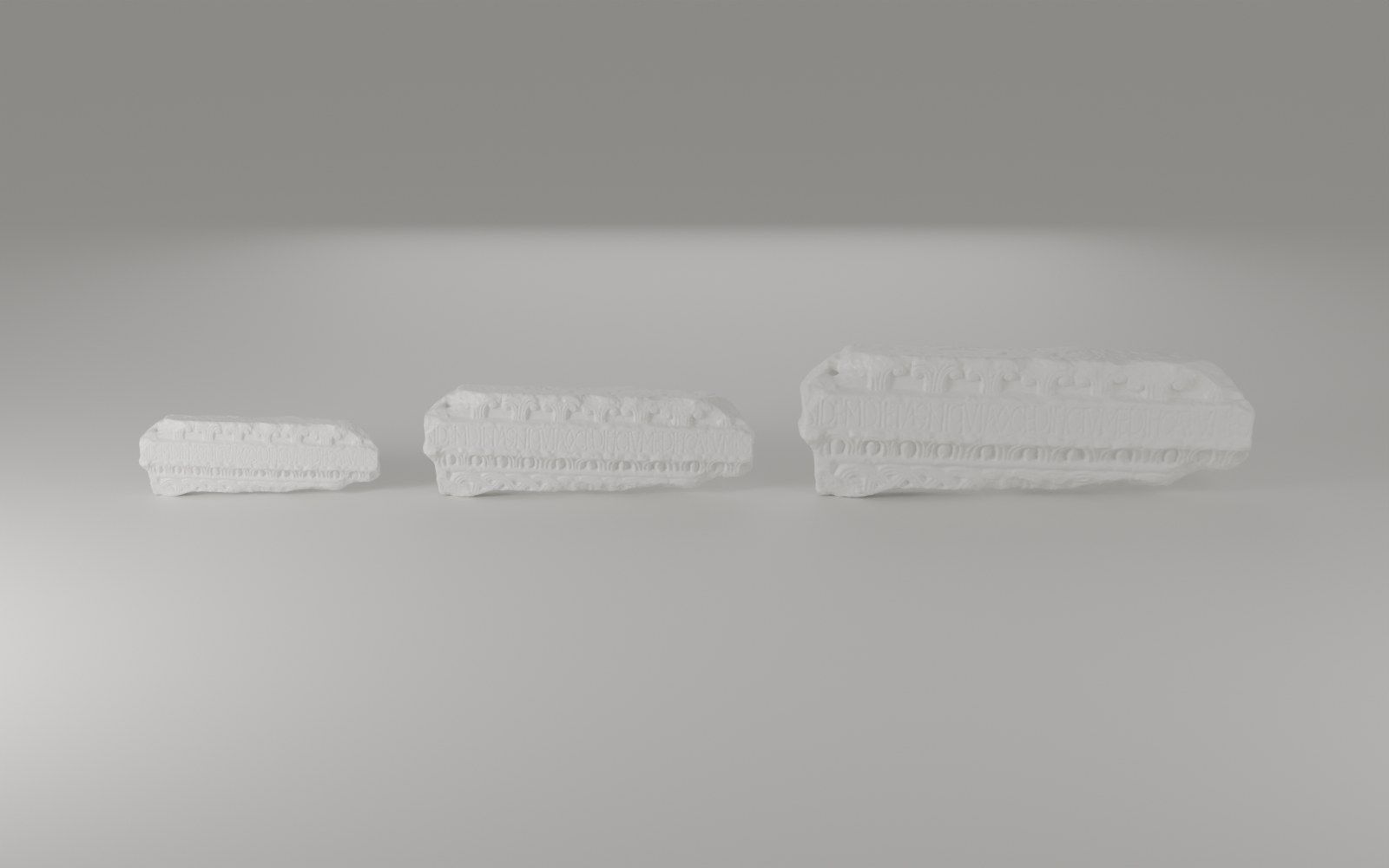
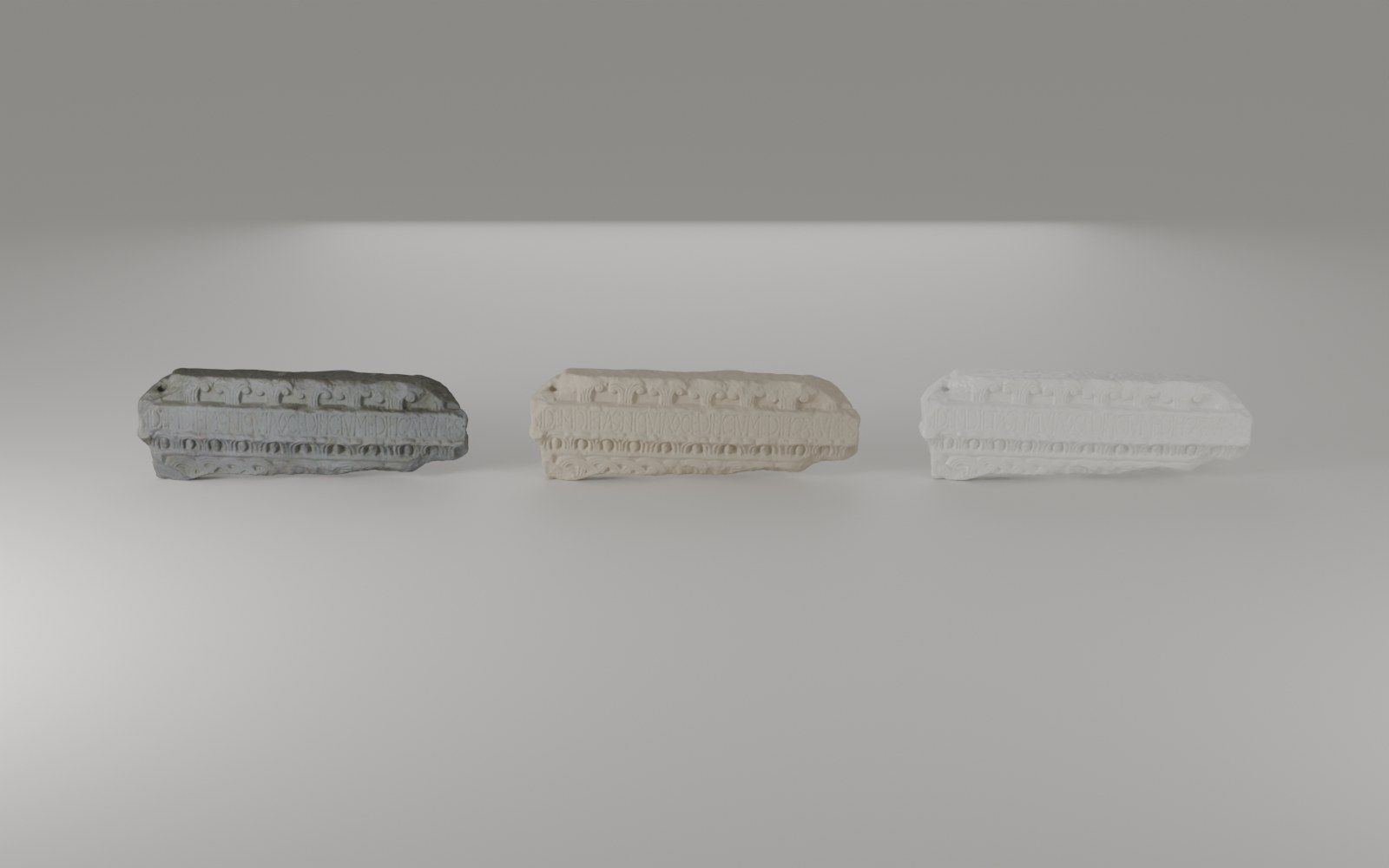
Renders of the 3D model in the proposed replica sizes and materials.
- Full colour of the original
- Full-colour gypsum: the replica carries the colour and texture of the 3D model itself. Closest to the look of the original.
- Stone composite and cast marble
- For carved stone: the altar, the ciborium, the coat of arms, plaques and fragments. A matte stone surface; relief and letters stay sharp.
The texts, measurements and reconstructions on this site are the analysis of the project implementer (3DExperts) and do not represent the views of the Tourist Organisation of Ulcinj, the Centre for Culture Ulcinj or the Museum of Ulcinj. The findings and interpretations are to be confirmed by the competent institutions and specialists engaged in this research.
Literature and sources (15)
- T. Koprivica, „Ulcinj, ciborijum“, Leksikon likovne umjetnosti Crne Gore, CANU — leks.canu.ac.me/web/llucg.php?OID=3982
- Narodni muzej Srbije, „Deo ciborijuma iz Ulcinja, IX vek“, objava na zvaničnoj Facebook stranici muzeja — www.facebook.com/narodnimuzej/posts/10157807239194646
- J. Kovačević, „Od doseljavanja Slovena do kraja XII vijeka“, Istorija Crne Gore I, Titograd 1967.
- Đ. Bošković, P. Mijović, M. Kovačević, Ulcinj I, Beograd 1981.
- P. Mijović, „Ulcinjski ciborijum“, Starinar n. s. XXXVI (1985), 91–103.
- P. Mijović, „Ulcinjski ciborijum“, Pradavne i davne kulture Crne Gore, Titograd 1987, 151–169.
- D. Preradović-Petrović, „Ulcinjski ciborijum – natpis i reljefne predstave“, Godišnjak Pomorskog muzeja u Kotoru L (2002), 247–264.
- P. Vežić, M. Lončar, Hoc tigmen: ciboriji ranoga srednjeg vijeka na tlu Istre i Dalmacije, Zadar 2009.
- I. Stevović, „Emperor in the Altar: An Iconoclastic Era Ciborium from Ulcinj (Montenegro)“, u: Texts – Inscriptions – Images, Art Readings 2016 (ur. E. Moutafov, J. Erdeljan), Sofija 2017, 49–67.
- M. Gogić, „Prilog proučavanju ciborijuma iz sakristije katedrale Sv. Tripuna posvećenog Petilovrijencima“, Istorijski zapisi 2017/1–2.
- Maps of Power (Austrijska akademija nauka), OpenAtlas: „Ciborium from Ulcinj“ — mop-openatlas.oeaw.ac.at/api/entity/132738
- CANU, Leksikon arheologije Crne Gore, odrednica „Ulcinj“ (M. Vrzić, A. Ljuljđuraj) — leks.canu.ac.me/web/arhcg.php?OID=7115
- CANU, Leksikon arheologije Crne Gore, fotografija ovog ulomka — leks.canu.ac.me/web/Slike/Fig-ARHCG-7115-9213.jpg
- CANU, Leksikon arheologije Crne Gore, odrednica „Ciborijum“ (T. Koprivica, A. Ljuljđuraj) — leks.canu.ac.me/web/arhcg.php?OID=6669
- M. Zornija, „O načinu funkcionisanja predromaničkih klesarskih atelijera na primjeru Kotorske klesarske radionice“, Ars Adriatica 7, 2017, 47–64.
From the same collection
Fragment of a decorative doorframe
13th century (P. Mijović)
IHS plaque with lions
Venetian period, 15th–16th century (Ulcinj under Venice 1421–1571)